
Does Air Pollution Actually Make Sunsets Better?
Common wisdom says pollution makes sunsets prettier. In most cases it does the opposite, muting the reds and oranges. Volcanic ash is the rare exception.

You have probably heard that pollution creates beautiful sunsets. It sounds logical. More stuff in the air, more color.
It is backwards. Stephen Corfidi, a meteorologist at NOAA’s Storm Prediction Center, put it plainly in the standard reference on the subject: relatively clean air is the main ingredient common to brightly colored sunrises and sunsets, and aerosols in the lower atmosphere subdue sky color rather than enhancing it. The vivid oranges and reds of clean air give way to pale yellows and pinks when haze moves in.
The Myth: Pollution Equals Better Sunsets
This idea has been floating around for decades. People see a hazy sky turn pinkish at dusk and assume the haze helped. Some cities with heavy smog do get colorful skies from time to time. But the smog itself is not the reason.
The confusion comes from mixing up different types of particles in the atmosphere. Not all particles affect light the same way. Size and altitude matter a lot.
How Sunsets Actually Get Their Color
Sunset colors come from a process called Rayleigh scattering. When sunlight passes through the atmosphere, air molecules scatter shorter wavelengths (blue and violet) away from your line of sight. That leaves the longer wavelengths (red, orange, and yellow) to reach your eyes.
At sunset, sunlight travels through more atmosphere than at noon. This extra distance scatters even more blue light away. The result is those warm colors we love.
Clean, dry air with a few high clouds creates the best conditions. The clouds catch the colored light and reflect it across the sky. That is how you get a full, vivid sunset.
Why Pollution Makes Sunsets Worse
Ground-level pollution (smog, car exhaust, industrial haze) fills the lower atmosphere with large particles. These particles are much bigger than air molecules. They scatter all wavelengths of light equally. Scientists call this Mie scattering.
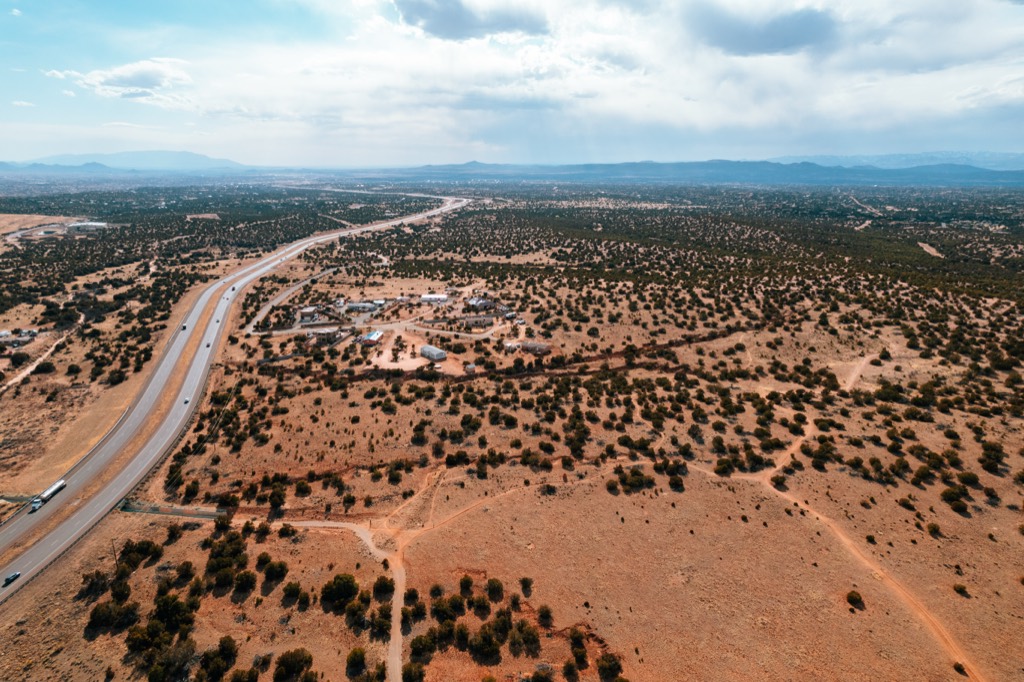
Haze over northern New Mexico in daylight. The nearby ground keeps its color while the distant ranges wash out to flat gray-blue. That is the same neutral scattering that mutes a sunset, just easier to see at midday when you have something to compare against.
Because those particles come in a wide range of sizes, the scattering they produce barely depends on wavelength. That is the definition of gray. Instead of separating colors, they blend them back together, so you get a washed-out sky rather than rich reds and oranges. Pollution also attenuates the light overall, especially when the sun is low and its path through the air is longest, so the whole scene loses brightness on top of losing color.
But What About Red Smoke Suns?
This is the observation that keeps the myth alive, and it deserves a straight answer.
When wildfire smoke moves in, the sun itself often turns a deep, striking red, dim enough to look at without squinting. That is real. Smoke particles are efficient at removing the shorter wavelengths from the direct beam, so what survives the trip to your eye is heavily reddened.
But look away from the sun and the rest of the sky is flat brown or milky gray. You gained a dramatic disk and lost the sunset. A colorful sunset needs color spread across the sky, lighting up clouds and gradients, and smoke is very good at preventing exactly that.
So both things are true: heavy aerosol reddens the sun and ruins the sky. People remember the sun.
What Actually Creates Stunning Sunsets
Three conditions do most of the work, and two of them are about what is missing rather than what is present.
Clean air comes first, because color separation through Rayleigh scattering only survives if there are few large particles to blur it back together. Dry air matters for the same reason: water vapor and the damp haze it forms scatter neutrally, and every point of humidity you lose is a point of contrast you keep.
The one thing you actively want is high cloud. Cirrus and altocumulus sit above the shadow of the terrain and the thick air near the surface, so they can still be lit from underneath after the sun has gone. They are the screen the color gets projected onto, which is why an empty sky rarely produces the kind of sunset people photograph.
The evening after a storm gives you all three at once. Rain scrubs dust and pollution out of the lower atmosphere, the air behind a front is drier, and departing systems usually leave high cloud trailing over a clearing western horizon.
Stratospheric aerosol from a major volcanic eruption is the rare case where adding particles helps, and it works for reasons that have nothing to do with smog. That is worth its own section.
Volcanic Ash vs. Smog: A Key Difference
People sometimes point to volcanic sunsets as proof that “particles in the air” help. But volcanic ash behaves very differently from city smog.
A major eruption injects sulfur dioxide into the stratosphere, roughly 10 to 20 miles up, where it converts to a fine sulfate haze. Two things make that different from smog. The particles form at a consistently small size, small enough that their scattering is still wavelength-dependent, and they sit far above the weather with no rain to wash them out, so they spread worldwide and linger for years.
The result is a distinctive purple glow high in the sky after sunset, well after the ordinary colors have faded. Following the 1991 eruption of Mount Pinatubo, that afterglow showed up around the globe for about two years.
Smog stays trapped in the lowest kilometer or two of the atmosphere, in a wide range of particle sizes, directly in your line of sight. Same three words, particles in air, opposite outcome.
Where to See the Best Sunsets
If you want the best sunsets, look for places with clean air and open views. Coastal areas, mountains, deserts, and rural regions tend to deliver the most colorful skies.
Big cities can still have great sunsets, especially after rain or on windy days that clear the air. The buildings and skyline can even add drama to the scene. But on a smoggy, stagnant day, do not expect much.
You can check your local air quality index (AQI) before heading out. Lower AQI numbers generally mean better conditions for sunset viewing.
What to Actually Look For
Air pollution does not improve sunsets. The best ones happen when the air is clean and there are high, thin clouds to catch the light after the sun is already down.
If you want to stack the odds: check the air quality index, go the evening after a front passes, find an open western horizon, and stay out for the 20 minutes after sunset when high clouds do most of the work. Dry air helps as much as clean air, which is why winter sunsets and desert sunsets tend to win.
Check SunriseSunset.io for sunset and twilight times anywhere.
Frequently Asked Questions
Does pollution make sunsets more colorful?
No. NOAA’s reference on the subject is direct about it: aerosols in the lower atmosphere subdue sky color rather than enhancing it. Smog and haze scatter every wavelength about equally, so instead of separating red from blue they mix the colors back into gray.
Why does the sun turn deep red during wildfire smoke, then?
Smoke reddens the direct beam very efficiently, so the disk itself can go a dramatic blood red and dim enough to look at. The rest of the sky goes flat brown at the same time. You get a striking sun and no sunset, and people remember the sun.
Why are sunsets red in the first place?
Sunlight reaching you at sunset has taken a long slanted path through the atmosphere, and air molecules scatter short wavelengths far more strongly than long ones. Blue and violet get thrown out of the beam along the way. What is left by the time it arrives is red and orange. The same process makes the midday sky blue, seen from the other side.
Do volcanic eruptions really improve sunsets?
Yes, and it is the one genuine exception. A major eruption puts sulfur dioxide into the stratosphere, where it converts to a fine sulfate haze at a consistently small particle size, above the weather and out of reach of rain. That produces a distinctive purple glow high in the sky after sunset. Pinatubo’s lasted about two years worldwide.
Does the air quality index predict a good sunset?
Loosely. A low AQI means fewer of the large lower-atmosphere particles that mute color, so it is a reasonable first check. It tells you nothing about humidity or whether there is high cloud in the west, and those matter at least as much.