
Can There Be a Beautiful Sunset Without Clouds?
Yes, and a cloudless sky shows you things a cloudy one hides: Earth's shadow, the Belt of Venus, the purple light, and the green flash. What to look for and when.

A cloudless sunset is a different event, not a lesser one. Clouds give you the drama. A clear sky gives you a set of subtler phenomena that clouds actively hide, and most people have never gone looking for them.
Why Clouds Get the Credit

Aerial sunset over Pittsfield, Mass
Clouds are screens. Once the sun is below your horizon it is still lighting the atmosphere above you, and high and mid-level clouds catch that light from underneath. Their texture breaks it into a patchwork of different brightnesses, which is what makes a cloudy sunset photograph well.
That only works with the right clouds. High cirrus and altocumulus glow; low stratus usually just goes gray, because it sits in the shadow of the thicker air and the terrain to your west. You also need a clear gap at the western horizon so the light can reach them in the first place.
The Cloudless Gradient
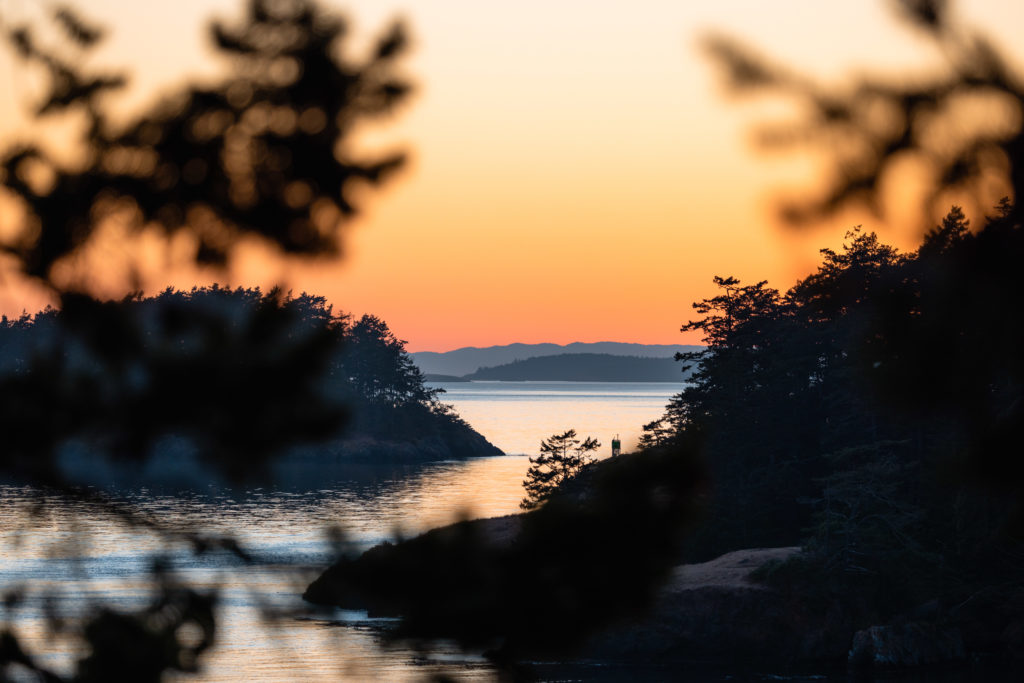
Clear sunset over Washington State
With no clouds, you see the atmosphere itself doing the work.
Sunlight arriving at a shallow angle takes a long path through the air, and Rayleigh scattering strips out the short wavelengths along the way. What is left is red and orange near the horizon, grading up through yellow and green-tinged white into the deep blue of the sky overhead. The gradient is smooth, unbroken, and covers most of the visible spectrum in one continuous sweep. Clouds interrupt it.
Clear evenings also give photographers clean silhouettes. A ridgeline or skyline against an even gradient is a much simpler picture than the same subject against a busy sky.
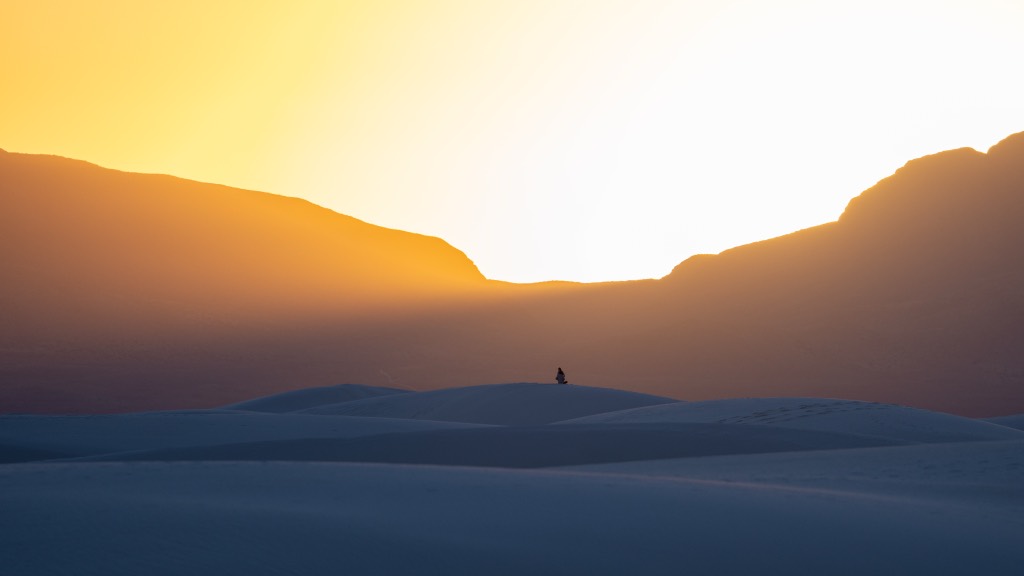
White Sands National Park, New Mexico. No clouds at all: the San Andres range reduced to a flat silhouette, and the sky running from gold at the horizon into pale blue overhead in one unbroken sweep. Desert air this dry is what keeps the gradient clean.
What Only a Clear Sky Shows You
Four things worth staying out for, all of which need an unobstructed sky.
Earth’s shadow. Turn around. Starting a few minutes after sunset, a dark blue-gray band rises in the east. That is the planet’s own shadow projected onto the atmosphere, and it climbs as the sun sinks further. It is one of the easiest astronomical phenomena to see and one of the least noticed.
The Belt of Venus. Directly above Earth’s shadow sits a pink or salmon arch, roughly 10 to 20 degrees up. It is sunlight that has already been reddened by its long path through the atmosphere and then backscattered toward you. Clean, dry air makes it obvious; haze erases it.
The purple light. On some evenings, 15 to 25 minutes after sunset, the western sky turns a distinct violet well above the horizon. This comes from sunlight scattering off fine aerosol high in the stratosphere, and it is far stronger in the years following a large volcanic eruption. Nothing to do with the ordinary orange band lower down.
The green flash. A brief green rim or spot at the top edge of the sun in the last second or two before it disappears. It gets its own section below, because it is the one on this list that people spend years failing to catch.
The Green Flash
The atmosphere disperses sunlight slightly, the way a weak prism does, so the sun is really a stack of slightly offset colored images. The red image sits lowest and sets first; the green image is still above the horizon for a fraction of a second after it. That last sliver is the flash.
The obvious question is why it is green rather than blue or violet, since those are bent more. They are also scattered more, and the sunlight reaching you at the horizon has taken the longest possible path through the atmosphere. The blue and violet have been stripped out along the way. Green is the shortest wavelength that survives the trip.
Two conditions decide whether you see it. You need a sharp, distant, unobstructed horizon, which in practice means the ocean, a large lake, or a desert plain. And you need air clean enough that the sun stays bright right to the end rather than dimming into a red mush a degree or two up, which is why hazy evenings never produce one no matter how clear the sky looks overhead.
Astronomers sort green flashes into a few types, and knowing them helps because they look different:
- Inferior-mirage flash. The common one. A flat oval separates from the top of a distorted, hourglass-shaped sun. It needs the surface to be warmer than the air above it, so it turns up when cool air has moved over warmer water.
- Mock-mirage flash. Thin strips of green peel off the top of the disk as it sinks through a temperature inversion. This one works from elevation, which means you do not need to be at sea level.
- Sub-duct flash. Rare, and the one worth chasing. The upper rim can stay green for fifteen seconds or more instead of one or two.
- Green ray. A shaft of green appearing to shoot up from the horizon, thought to be an ordinary flash scattered against the sky by marine aerosol.
Duration is the part most descriptions get wrong. One to two seconds is typical, but it is a function of how fast the sun is setting, so it is longer the farther you are from the equator. Five members of the Byrd expedition at Little America in Antarctica watched an intermittent green flash for 35 minutes on 16 October 1929, which is possible because at that latitude the sun crawls along the horizon rather than dropping through it.
Sunrise works too, and is harder only because you have to be looking at exactly the right spot before the sun arrives rather than following it down.
Do not stare at the sun waiting for it. Watch the horizon around the disk, and look directly at it only in the final couple of seconds, once it has dimmed enough to be comfortable. A long lens and burst mode will catch what your eye is not fast enough to be sure of, and photographing it settles the old argument about whether the flash is real or an afterimage on your retina.
About Haze
A widely repeated claim says a light haze makes a cloudless sunset more vibrant. That needs a qualification, because taken at face value it contradicts what the atmospheric science says.
Haze particles are large compared with a wavelength of light, so they scatter all colors about equally and turn separated color back into gray. The effect on a clear-sky sunset is to compress the color into a narrow, dull band at the horizon while flattening everything above it. The gradient, the Belt of Venus, and any chance at a green flash all go with it. NOAA’s reference on sunset color is direct about this: aerosols in the lower atmosphere subdue sky color rather than enhancing it.
What genuinely does help is fine particles high up, in the stratosphere, above the weather. Those are the ones that produce the purple light. Ground-level haze is a different thing with the opposite effect, and pollution does not make sunsets better.
Timing a Clear Evening
The best part of a cloudless sunset happens after the sun is gone, which is precisely when most people leave.
Earth’s shadow and the Belt of Venus show up in the 10 to 25 minutes after sunset, during civil twilight. The purple light, if it appears, comes toward the end of that window. Blue hour follows. Only after all of that does the sky settle toward nautical and then astronomical twilight, when stars fill in and the horizon glow finally goes.
Check when civil twilight ends where you are and plan to stay until then. On a clear evening it is between 21 minutes near the equator and 48 minutes in London in June.
Frequently Asked Questions
Can a sunset be good with no clouds at all?
Yes, it is just a different event. You trade the patchwork of lit cloud for a smooth full-spectrum gradient and for four things clouds hide: Earth’s shadow, the Belt of Venus, the purple light, and the green flash.
Is the green flash real?
Yes, and it photographs. It is atmospheric dispersion separating the sun into slightly offset colored images, so the green one is briefly the last still above the horizon. The reason it is green rather than blue is that blue has been scattered out of the beam over its long path through the atmosphere.
How rare is the green flash?
Far less rare than its reputation. From a coastline with clean air and an unobstructed sea horizon, people who look on purpose catch one within a handful of clear evenings. The reputation comes from most people watching from places with hills, buildings, or haze in the way.
What time do Earth’s shadow and the Belt of Venus appear?
Roughly 10 to 25 minutes after sunset, during civil twilight, in the eastern sky opposite the sun. Earth’s shadow is the dark blue-gray band along the horizon and the Belt of Venus is the pink arch on top of it, about 10 to 20 degrees up.
Why is my clear sunset just plain orange with no color spread?
Usually haze. Lower-atmosphere aerosol scatters every wavelength about equally, which compresses the color into a narrow dull band at the horizon and flattens everything above it. Dry, clean air is what produces the full gradient.