
Why Watching the Sunset Makes You Happier (The Science of Light)
Sunset viewing does lift your mood, but not for the reasons most articles claim. Here is what the research actually shows about evening light, cortisol, and awe.

Search for the science of sunsets and you will find the same numbers everywhere: 20 minutes of sunset raises serotonin 15%, boosts dopamine 10%, drops cortisol. Those figures get copied between articles until they look like consensus.
No published study has measured them. Nobody has sat volunteers in front of a sunset and sampled their blood. The numbers appear to have been invented and then repeated.
The real research is less tidy and more useful. Three separate bodies of evidence explain why the end of the day feels good, and none of them require made-up percentages.
The Light Signal Your Eyes Are Reading
Your retina has a third class of photoreceptor most people never learn about. Alongside rods and cones sit intrinsically photosensitive retinal ganglion cells, or ipRGCs. They contribute almost nothing to what you see. Their job is to report how much light is around and what color it is.
These cells run on a pigment called melanopsin, which peaks in sensitivity at roughly 480 nanometers. That is blue. They are wired directly to the suprachiasmatic nucleus (SCN), a cluster of about 20,000 neurons in the hypothalamus that acts as your body’s master clock.
Here is the part that most sunset articles get backwards. Light does not trigger melatonin. Light suppresses it. All day, blue-rich daylight hitting your ipRGCs keeps melatonin production shut off. As the sun drops toward the horizon, the short wavelengths get scattered out of the direct beam first, so the light reaching your eyes loses most of its blue content. The suppression signal weakens, and your pineal gland is finally allowed to start releasing melatonin.
So sunset light does not switch anything on. It stops switching something off. The distinction matters, because it explains why the fix for bad sleep is removing evening blue light rather than adding any particular kind of light.
What Your Eyes Actually Do During a Sunset
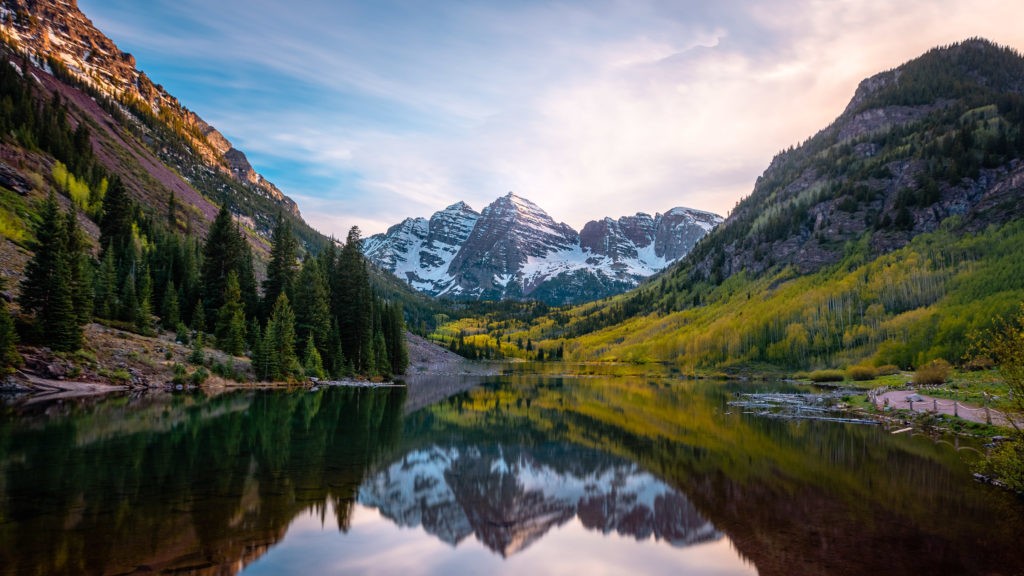
Sunset at Maroon Bells in Colorado
The SCN is not measuring beauty. It is measuring two things: total brightness, and the ratio of short to long wavelengths. Both fall off sharply in the half hour around sunset, and that combination is the strongest timing cue your body gets all day.
Standing outside gives your clock an unambiguous reading. Sitting indoors under lights that stay the same color at 9pm as they were at noon gives it a confusing one, and a phone or laptop held close to your face keeps feeding your ipRGCs exactly the wavelength they are tuned for.
A 2015 study in PNAS by Chang and colleagues at Brigham and Women’s Hospital had people read on a light-emitting tablet in the evening for several nights. Compared with reading a printed book, the tablet suppressed melatonin, pushed their circadian timing later, made them take longer to fall asleep, and left them less alert the next morning.
Going outside at sunset is the cheapest available correction. You get the right spectrum at the right hour, and you are not looking at a screen for the length of time you are out there. Both of those help.
One caution: do not stare directly at the sun, even when it is low and looks dim. Look at the sky and the color instead. Your eyes get the same spectral information from the sky, and near the horizon the sun’s brightness varies more than your blink reflex can be trusted to handle.
What 20 Minutes Outside Actually Does
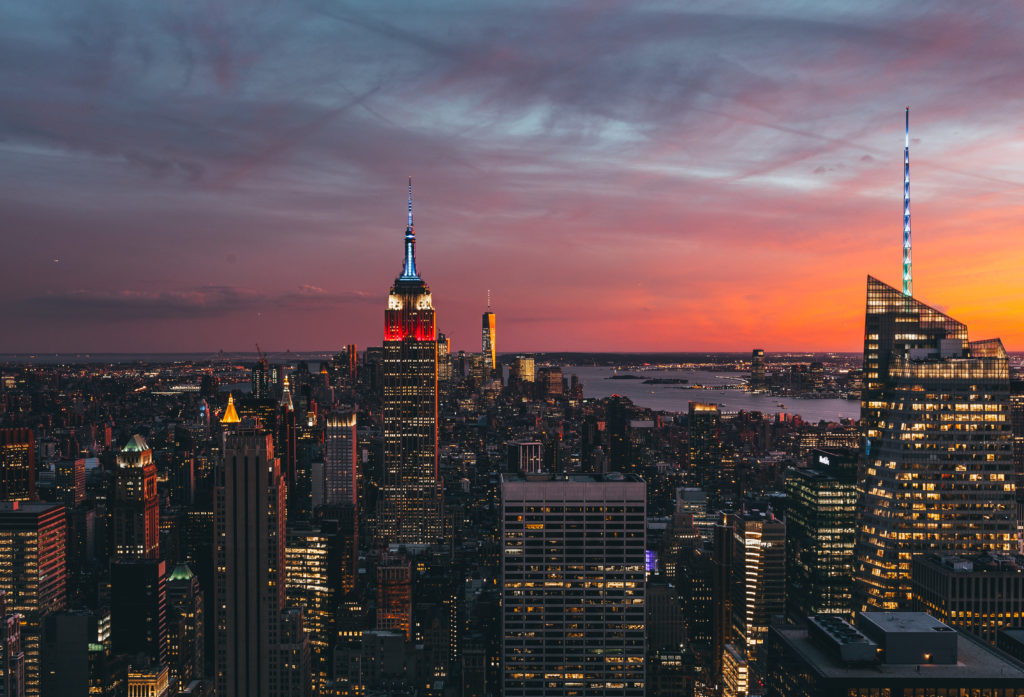
Sunset in New York City
The 20-minute figure that gets attached to sunsets does trace back to a real experiment, just not one about sunsets.
In 2019, MaryCarol Hunter, Brenda Gillespie, and Sophie Chen published a study in Frontiers in Psychology that followed 36 city dwellers over eight weeks. Participants chose their own “nature pill”: at least three times a week, at least ten minutes, anywhere that felt like nature to them, in daylight, without aerobic exercise, phone calls, reading, or social media. The researchers collected saliva before and after.
Cortisol fell at about 21% per hour, and the efficiency peaked somewhere between 20 and 30 minutes. Longer sessions kept helping, but the return per minute dropped off.
That is a solid result, and it applies to sunset watching because sunset watching is a nature experience that happens to have a built-in start time and a natural length. It does not tell you anything specific about sunsets versus, say, sitting under a tree at 2pm. What it does tell you is that the dose is small. Twenty minutes is enough.
Awe Quiets the Part of Your Brain That Talks About You
The third mechanism is the one people describe without having a word for it. Big skies make your problems feel smaller.
Michiel van Elk and colleagues ran an fMRI study, published in Human Brain Mapping in 2019, showing people awe-eliciting videos of vast natural scenes. The finding: default mode network activity went down, not up. The frontal pole, angular gyrus, and posterior cingulate cortex all quieted during awe compared with the absorption condition.
The default mode network is the circuitry that runs when you are not focused on anything external. It handles self-referential thought, autobiographical memory, and mental time travel into the future. It is also where rumination lives. Participants who reported the strongest awe also reported feeling that their sense of self had gotten smaller.
Plenty of popular writing gets this backwards and claims awe “activates” the default mode network to unlock creativity. The measurement points the other way. Awe turns down the self-talk. That is a better explanation for why 20 minutes at the water’s edge resets you than any story about a neurotransmitter percentage.
Does Sunlight Affect Serotonin at All?
Yes, but the evidence is seasonal rather than per-sunset.
Gavin Lambert’s team in Melbourne sampled blood directly from the internal jugular vein in 101 healthy men and published the results in The Lancet in 2002. Brain serotonin turnover was lowest in winter, and the rate of serotonin production tracked the amount of bright sunlight on the day of sampling.
That is real evidence connecting daylight to serotonin. It is also a study about total daily light exposure across seasons, measured in a hospital with a catheter in someone’s neck. Stretching it into “watching a sunset raises your serotonin by 15%” is not a small extrapolation. It is a different claim.
How to Get the Most Out of It
Nothing here requires a technique, but a few things measurably matter:
- Give it 20 minutes. That is where the cortisol data peaks, and it fits inside civil twilight, which runs about 21 minutes after sunset near the equator and 27 to 33 minutes at mid-latitudes.
- Actually go outside. Window glass cuts the light, and you lose the open sky that produces most of the awe response.
- Leave the phone in your pocket. The Hunter study specifically excluded phone use during the nature experience, and a screen puts 480 nanometer light back in your eyes at the exact moment your clock is trying to read the drop-off.
- Look at the whole sky, not just the sun. The color band opposite the sunset, where Earth’s shadow rises as a blue-gray arc under a pink glow, is often better than the sunset itself.
- Check the time first so you are outside before the good part. A twilight calculator will tell you when civil twilight ends where you are.
Sunset vs. Sunrise: Which Is Better for You?
They do different jobs, and the difference is about timing rather than beauty.
Morning light is the stronger circadian signal of the two. Bright, blue-rich light shortly after waking advances your clock, which is what you want if you struggle to fall asleep at night. Evening light does the opposite. It delays your clock, which is why the recommendation for evening is dim and warm rather than bright and blue.
Sunset viewing works because it is dim and warm and outdoors. If your goal is winding down and cutting stress at the end of the day, that is the one. If your goal is falling asleep earlier and waking up easier, morning light does more, and you can read about how sunrise timing is calculated to plan around it. Doing both is better than either.
Frequently Asked Questions
Does watching a sunset really raise serotonin by 15%?
There is no study behind that number. It circulates widely and has no traceable source. Sunlight and serotonin are genuinely connected, established by Lambert’s 2002 Lancet study on seasonal serotonin turnover, but no research has measured neurotransmitter changes during sunset viewing specifically.
How long should I watch a sunset to feel the benefits?
Around 20 minutes, based on the Hunter 2019 cortisol data for nature exposure generally. Shorter still helps. The efficiency of the stress reduction peaks between 20 and 30 minutes, so there is no need to make an evening of it.
Is watching a sunset better than watching a sunrise for your mood?
For winding down, yes. Evening light that is dim and low in blue lets melatonin production begin on schedule. Morning light does the opposite job, shifting your clock earlier and improving alertness. Neither is better in general; they are useful at different ends of the day.
Can watching a sunset help with anxiety?
The mechanism is plausible and partly measured. Awe reduces default mode network activity, and that network is heavily involved in rumination and future-focused worry. Time outdoors also lowers cortisol. That is not a treatment for an anxiety disorder, and no study has tested sunset viewing as one.
Does looking at sunset photos have the same effect?
For the circadian part, no. A photo does not deliver the spectral shift your ipRGCs are reading, and a phone screen actively works against it. For the awe part, images of vast scenes do produce a measurable response; van Elk’s fMRI study used video clips rather than real landscapes. So a photo can move you without doing anything for your body clock.
Why are winter sunsets more vivid?
Winter sunsets often look better mostly because cold air holds less water vapor, and water vapor is what turns clean color into haze. The sun also tracks lower all day at mid-latitudes in winter, which stretches the warm low-angle light across the whole afternoon instead of squeezing it into the last half hour.