
The Shortest Day of the Year (and Why Your Earliest Sunset Already Happened)
The December solstice is the shortest day, but the earliest sunset comes weeks before it and the latest sunrise weeks after. How far apart they fall depends on your latitude.

In the Northern Hemisphere the shortest day of the year falls on December 21 in most years, occasionally December 20 or 22. That part is simple. The part that confuses people every winter is that the earliest sunset does not happen on it, and neither does the latest sunrise.
In New York the sun sets at its earliest on December 7 and 8, two weeks before the solstice. By the solstice itself it is already setting about three minutes later. The latest sunrise does not arrive until the first days of January, two weeks after. The shortest day sits in the middle of those two events rather than on top of them.
How Far Apart They Fall Where You Are
The gap is not the same everywhere. It shrinks as you go north, and near the equator it is enormous.
| Place | Earliest sunset | Shortest day | Latest sunrise |
|---|---|---|---|
| Quito, Ecuador (0°) | Oct 30 to Nov 5 | no real minimum | Feb 8 to 15 |
| Miami (26°N) | Nov 27 to Dec 2 | Dec 21 | Jan 11 to 15 |
| Dallas (33°N) | Dec 2 to 5 | Dec 21 | Jan 6 to 10 |
| New York (41°N) | Dec 6 to 9 | Dec 21 | Jan 3 to 6 |
| Portland, Oregon (46°N) | Dec 8 to 11 | Dec 21 | Dec 31 to Jan 3 |
| London (52°N) | Dec 11 to 14 | Dec 21 | Dec 29 to Jan 1 |
| Anchorage (61°N) | Dec 15 to 17 | Dec 21 | Dec 25 to 27 |
Those are ranges rather than single dates because the turning point is genuinely flat. In New York, December 7 and December 8 share the same sunset time to the second, and every day from the 6th to the 9th is within five seconds of it. That is why two reputable sources will happily print different dates for the same city and both be right.
In Anchorage the earliest sunset and latest sunrise sit five days either side of the solstice. In Miami they sit three weeks either side. Quito has no meaningful shortest day at all, because day length there sits at about 12 hours 7 minutes and varies by under two minutes across the whole year, but it still has an earliest sunset, and it lands in early November.
Two things fall out of the table. The spread is symmetric around the solstice everywhere, and it widens as you approach the equator.
Why the Solar Day Is Not 24 Hours
A clock day is exactly 24 hours by definition. A solar day, measured from one solar noon to the next, is not. In late December it runs about 30 seconds long.
Two effects cause this, and in December they push the same way.
Earth’s orbit is an ellipse, and we are near our closest approach to the sun in early January. Orbital motion is fastest there, so Earth has to turn a little further each day to bring the sun back to the meridian.
Earth’s axis is also tilted, so the sun’s apparent path is inclined to the celestial equator rather than running along it. Near the solstices, more of the sun’s daily motion is parallel to the equator, which also lengthens the interval between one noon and the next.
Add them up and every solar noon in December arrives about 30 seconds later by the clock than the one before. Over the two weeks before the solstice that is about seven minutes of drift, and it carries sunrise and sunset along with it.
Two Clocks Running Against Each Other
Sunset time is set by two quantities moving at once: the length of the day, and where solar noon sits on the clock.
Coming into December, day length is still shrinking, which pulls sunset earlier. Solar noon is drifting later, which pushes sunset later. In early December the drift wins, sunset stops getting earlier, and it starts creeping back. Day length keeps shrinking until the solstice regardless, because the morning is still losing more than the evening is gaining.
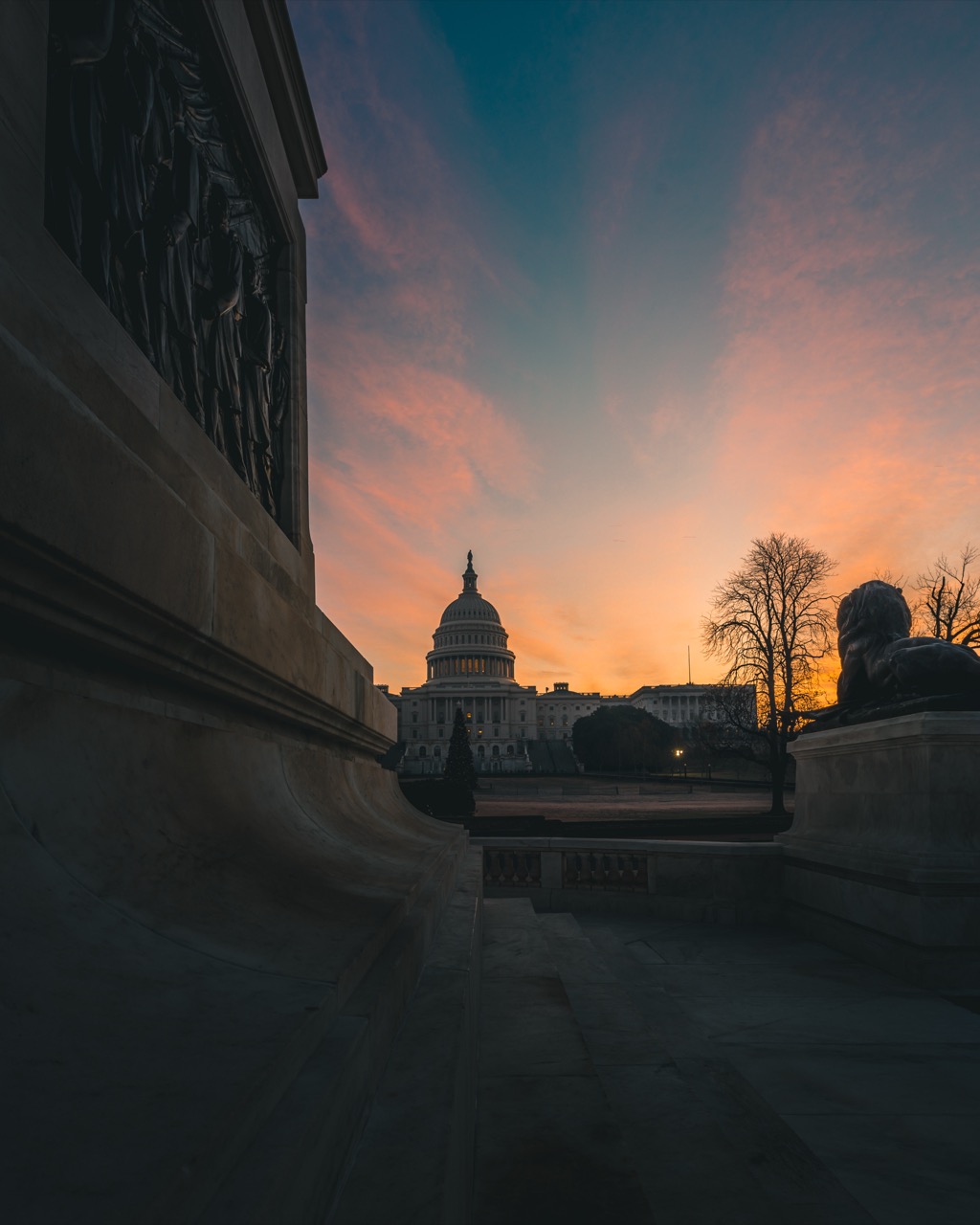
Washington DC in the second half of December, well after the evenings have started getting lighter and while the mornings are still getting darker
After the solstice the two swap roles. Day length starts growing, which pushes sunset later and sunrise earlier, but solar noon is still drifting later and holds sunrise back for another couple of weeks. That is why January mornings stay dark long after the evenings have started to open up.
The reason the gap narrows with latitude is that the noon drift is the same everywhere, roughly 30 seconds a day, while the change in day length is not. At high latitude the day is shortening fast near the solstice, so it overwhelms the drift within a few days. Near the equator the day barely changes at all, so the drift dominates for months.
What This Does Not Mean
The solstice is not the coldest day either, but that is a different effect with a different cause, and it lags by about a month rather than leading by two weeks. The oceans and ground keep releasing heat they stored in summer, so the coldest part of winter arrives in late January. Nothing about the sunset shift explains it.
Daylight saving time has nothing to do with any of this. The clocks in the United States and Europe have already gone back before any of these dates, and they stay put through January. The drift described here is astronomical and would happen on a clock that was never adjusted at all.
The effect is also not a rounding artifact or a quirk of how one site calculates times. It shows up in almanacs going back well before anyone was computing sunset with a program, and the December solar day genuinely is longer than 24 hours.
Watching It Happen
The easiest way to see it is to pull up your own location and step through December. The evenings stop getting darker around the first week of the month in the middle latitudes, sit flat for a fortnight, and start improving before the solstice arrives. The mornings keep getting worse the whole time.
If you want the exact dates where you live, the month calendar on any location page lists sunset day by day, and the flat spot in the first half of December is obvious once you know to look for it. The arithmetic behind those times is covered separately. The related asymmetry in how twilight length changes with latitude is worth reading alongside it, since the two combine to decide how dark your commute actually is.